


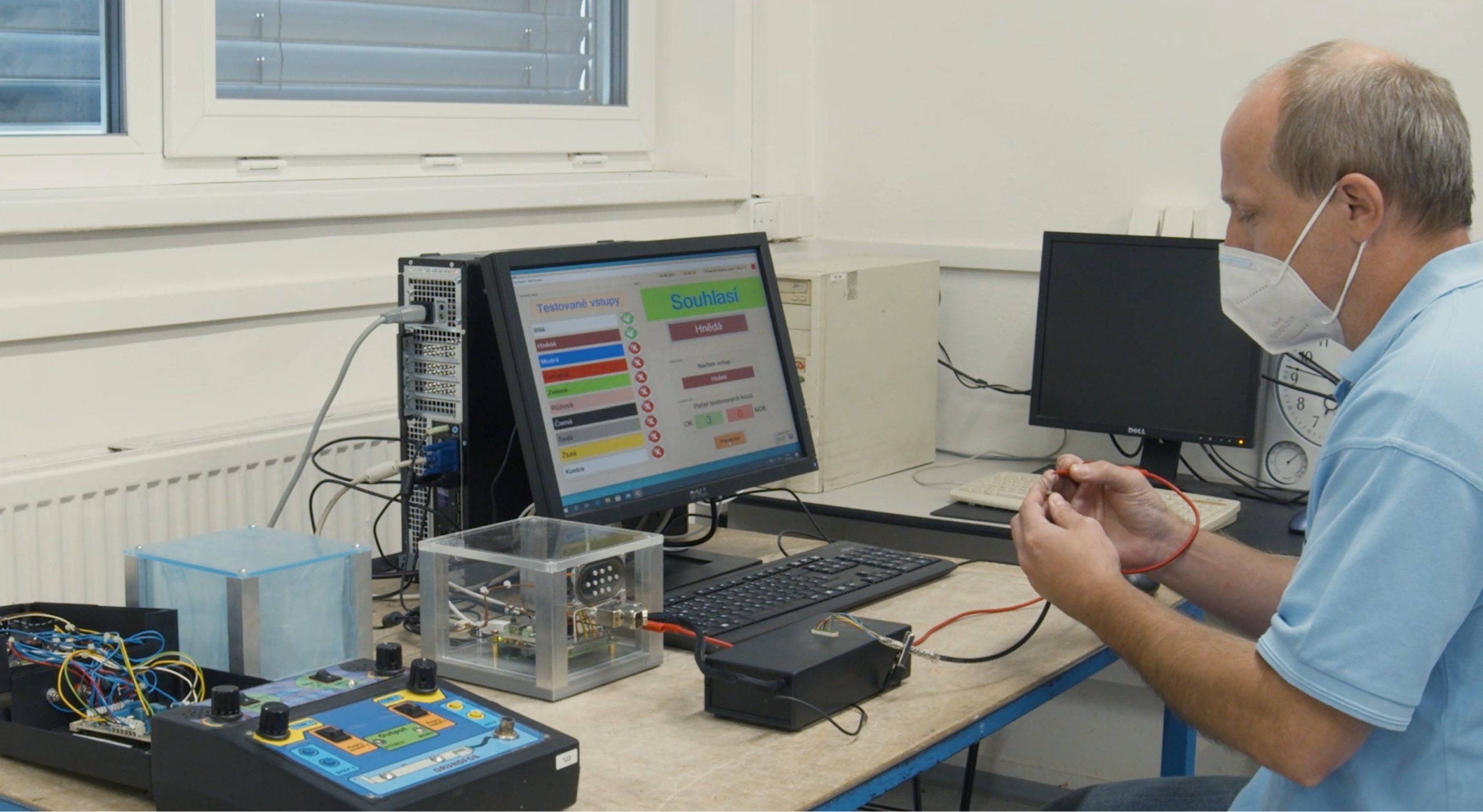
100% electrical testing is now considered a quality standard in cable assembly. Every assembled cable is tested, every connection is electrically checked, and every cable is clearly evaluated.
This approach is a central component of modern quality assurance. It ensures that every cable assembly is electrically correct and meets the respective industry requirements.
Anyone who wants to understand the contribution electrical testing makes to overall quality should look at what it reliably captures and how it is integrated into a holistic testing concept.
In this article, we show:
- which tasks electrical testing fulfills in cable assembly,
- what informative value it has,
- how it can be meaningfully supplemented,
- and how CiS integrates electrical testing into a structured quality management system.
Why is 100% electrical testing indispensable in connection technology?
In connection technology, final electrical testing is the last instance before delivery. It ensures that every cable connection is wired correctly, electrical continuity is present, and no short circuits exist. This check is indispensable, especially for complex cable harnesses or multipole connector assemblies.
At CiS, every assembled cable undergoes 100% final electrical testing. This ensures that no faulty cable connection leaves our facility. Electrical function is the foundation of every reliable cable assembly, and this foundation is tested without exception.
Die 100-%-elektrische Prüfung schafft damit Klarheit:
Die Kabelmontage erfüllt ihre elektrische Aufgabe vollständig und reproduzierbar.
What does electrical testing reliably capture?
100% electrical testing provides a clear and objective statement about the electrical condition of a cable assembly. It verifies whether all conductors are connected correctly, the wiring complies with the specification, and no impermissible short circuits or interruptions are present. In this way, it ensures that every assembled cable fully performs its electrical function.
Among the aspects tested are electrical continuity, correct pin assignment, and freedom from short circuits. The results are clearly measurable, reproducible, and documentable. This is precisely where the strength of electrical testing lies: it creates transparency and reliability based on concrete measured values.
For cable assembly, this means that every cable leaves production only once its conformity with the specification has been clearly verified. Electrical testing is therefore not a mere formal inspection step, but a robust proof of quality for the electrical function of every single cable connection.
Quality encompasses more than electrical function
The electrical function of a cable assembly is the indispensable foundation; it ensures that a cable connection technically fulfills its intended task. However, high-quality connection technology goes beyond that. Quality does not only mean that current flows, but that the entire execution remains permanently stable and resilient within the scope of its intended use.
In later use, a cable assembly is often exposed to mechanical, thermal, or environmental influences. Tensile forces, bending stress, vibrations, or temperature fluctuations impose requirements that go beyond pure electrical function. It is therefore crucial that the cable assembly is not only electrically correct, but also designed and executed in a well-considered structural and mechanical manner.
A holistic view of quality therefore considers not only electrical testing , but also aspects such as process stability and material selection. Only through the interaction of these factors does a cable connection emerge that not only performs well in the testing process, but also proves reliable in long-term use.
Supplementary tests for holistic quality
100% electrical testing forms the foundation of quality assurance in connection technology. However, to obtain a complete picture of product quality, it is supplemented by additional, specifically selected testing methods. The aim is to assess not only the electrical function, but also the mechanical stability and the workmanship quality of the entire cable assembly.
Mechanical testing plays an important role here. Pull tests, for example, provide information on whether cable connections and contact points are designed with sufficient stability and can withstand defined loads. They help assess the robustness of a cable assembly under realistic stresses and identify weak points at an early stage.
Visual inspection is also an integral part of a holistic testing concept. Visual checks make it possible to verify processing details such as strip lengths, strand routing, or the correct positioning of components. In combination with clearly defined inspection criteria, this check helps ensure consistently high workmanship quality.
What is decisive here is not the isolated consideration of individual testing methods, but their coordinated interaction. Electrical testing confirms functionality, while mechanical and visual inspections complement this statement with additional quality aspects. Only this combination creates a comprehensively assured cable connection that meets the requirements of demanding applications over the long term.
Detailed electrical evaluation: making process stability visible
In addition to classic 100% electrical functional testing, advanced electrical parameters can provide valuable indications of the stability and controllability of manufacturing processes. While final testing clearly confirms that a cable assembly functions correctly from an electrical standpoint, additional parameters enable a more differentiated assessment of workmanship quality.
Here, the question is less whether a cable connection conducts electricity and more how consistently and in how controlled a manner it was manufactured. Detailed electrical evaluations, for example through the analysis of contact resistances or comparable measured values, make it visible whether processes operate reproducibly and remain within defined tolerances.
What matters here is not the individual measured value, but its stability throughout the entire series production. Low variation and consistent results show that manufacturing parameters are maintained precisely and that electrical testing is embedded in a structured quality management system.
Such detailed evaluations meaningfully expand the informative value of 100% electrical testing. They deepen transparency regarding process quality and help ensure that cable assemblies are not only functionally correct, but also permanently stable.
Reproducibility as a key quality characteristic
A single positive test result provides a snapshot. It confirms that a specific cable assembly meets the defined requirements. What is decisive for sustainable quality, however, is whether this result can be achieved again and again under identical conditions. This is precisely where reproducibility comes into play.
Reproducible test results show that testing processes are stable and operate within clearly defined parameters. When electrical test values—such as continuity measurements or other measurements—remain consistent across production runs and show only low variation, this is a clear sign of controlled manufacturing processes. Quality then does not arise by chance, but is the result of robust production processes.
In connection technology, reproducibility means one thing above all: reliability. Customers can rely on the fact that every single cable not only meets the specification, but was also manufactured under identical conditions with consistent precision.
At CiS, reproducibility is therefore not a by-product, but a central objective of quality assurance. Through documented testing processes, clear specifications, and continuous process monitoring, we ensure that electrical testing and manufacturing quality remain in lasting alignment.
Assessing electrical tests in the application context
Electrical testing only unfolds its full informative value when considered in the context of the later application. Not every cable assembly is used under the same conditions. Different industries, installation situations, and environmental requirements lead to varying load profiles—electrical as well as mechanical.
An assembled cable used in a static installation places different demands on connection technology than an application involving permanent movement, temperature fluctuations, or increased vibration exposure. Electrical testing remains indispensable in both cases, but its evaluation must take place within the respective context.
For this reason, testing methods at CiS are not considered in isolation, but are selected together with the customer based on the application. Electrical requirements, normative specifications, and environmental conditions are incorporated into the definition of the testing concept. In this way, we ensure that electrical testing not only fulfills formal criteria, but also genuinely contributes to safeguarding the later operating conditions.
Quality arises when testing methods are used in a targeted manner. It is not the maximum number of tests that determines reliability, but their precise alignment with the respective application within a robust production process. It is precisely this interplay that makes electrical testing an effective instrument within holistic quality assurance in connection technology.
CiS in practice: systematically safeguarding quality
At CiS, 100% electrical testing is not an isolated inspection step, but an integral part of the holistic quality management system. Every assembled cable passes through defined testing processes that are documented, traceable, and fully auditable. In this way, we ensure that electrical requirements are consistently met.
However, quality does not begin only at final inspection. Components are already checked during incoming goods inspection in order to create a stable basis for subsequent cable assemblies. During production, in-process inspections and operator self-checks ensure that deviations are identified and corrected at an early stage. Final electrical testing then forms the binding conclusion before a cable assembly is delivered.
Our processes are certified according to international standards and are subject to regular internal as well as external audits. This is complemented by continuous training for our employees and ongoing optimization of manufacturing and testing processes.
In this way, electrical testing is embedded in a stable, structured quality environment. The result is a cable connection that not only fulfills its electrical function, but is also safeguarded over the long term through controlled processes, reproducible results, and documented testing.
Our commitment is clear: connection technology should not only comply with specifications, but also function reliably over the long term—backed by systematic testing procedures and a consistently practiced understanding of quality.

The information in our blog posts is aimed at technically proficient readers and is based on the current state of knowledge at the time of publication. We do not assume any liability for its implementation. **Automatic AI translation**