


In industry, requirements are continuously increasing: greater product variety, shorter product life cycles, rising quality standards, and growing cost pressure. At the same time, many companies are increasingly seeking to focus more strongly on their core competencies, such as development and market development.
This is exactly where box building—or rather box build assembly—comes in.
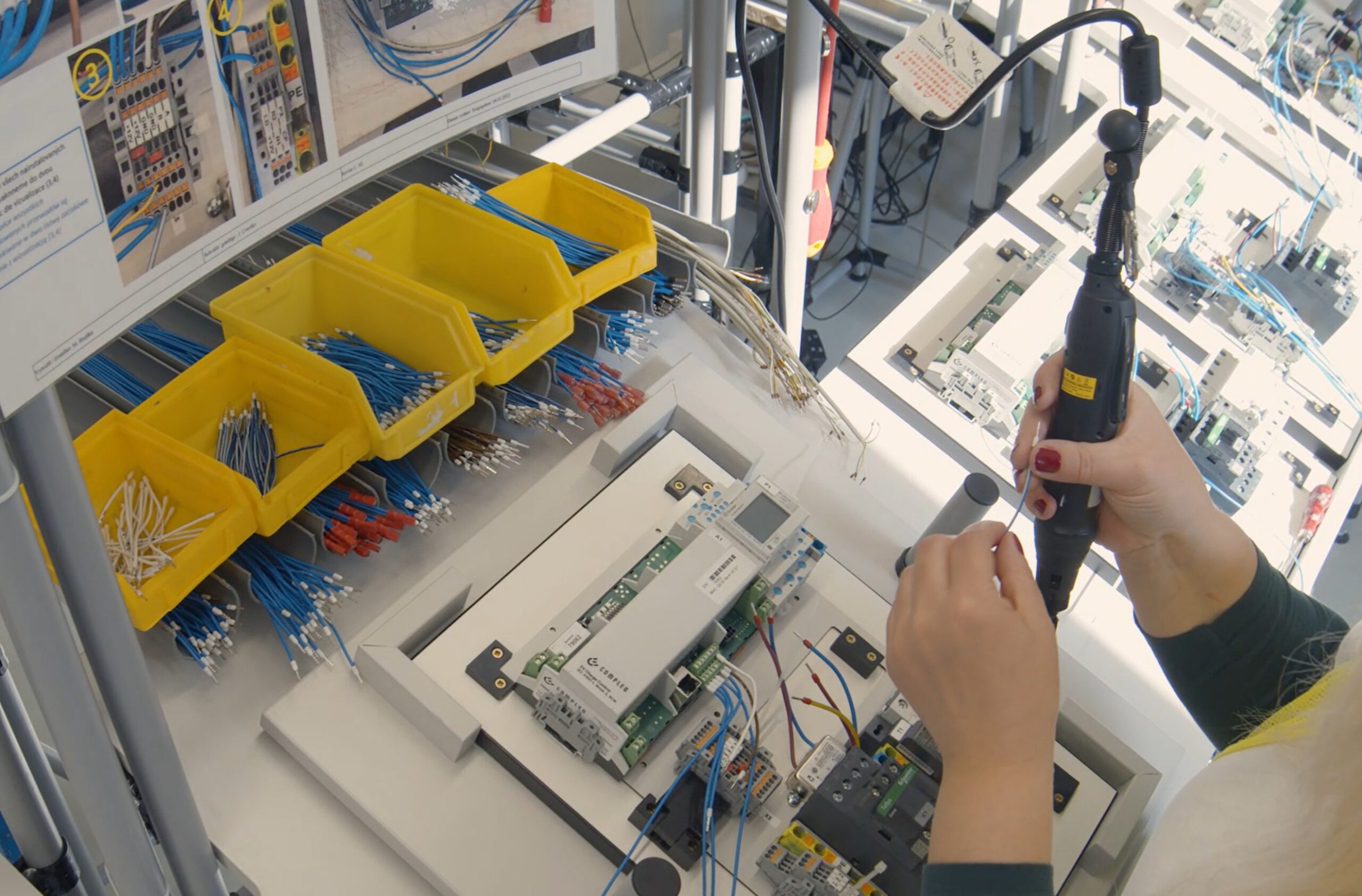
As a holistic integration process, box building combines electronic assemblies (PCBAs), cable and conductor systems, electronic and electromechanical components, HMI elements, and mechanical parts within a common housing to create a functional, tested, and ready-to-connect unit.
The result is fully integrated devices or ready-to-install assemblies that can be incorporated directly into machines, systems, or end devices.
But what does box building mean in concrete terms? Why is it so relevant for industry today? And what really matters in this context?
In this article, you will learn:
- what is meant by box building or box build assembly,
- what role quality and process reliability play,
- what is particularly important in complex system integration projects,
- and how CiS implements box building holistically for its customers.
What is box building in industrial equipment manufacturing?
Box building describes the electromechanical system integration of electronic, electrical, and mechanical components into a ready-to-install unit—often within a housing or a defined device structure.
The focus is on industrial equipment and machines in which numerous components are brought together into a robust, durable overall system.
Typical elements of such box building include, among others:
- Printed circuit boards and electronic assemblies (PCBAs) (e.g. controllers, power electronics),
- Cable and conductor systems, connectors, and electromechanical components (relays, contactors, fuses),
- Sensors and actuators (e.g. temperature, level, or position sensors, motors, drives),
- HMI units such as displays, membrane keyboards, push buttons, control panels, or complete input systems,
- Housings, chassis, mounting plates, and mechanical brackets.
Box building goes far beyond the mere assembly of components. It encompasses the entire process chain—from technical coordination and material disposition to mechanical and electrical integration, as well as testing, documentation, and logistics-ready packaging.
Depending on the project, CiS can also take over the loading of firmware or parameter settings onto controllers and drives—the clear focus, however, is on electromechanical system integration.
The end result is a tested assembly or a complete device that can be installed and commissioned directly in machines, systems, or industrial end equipment.
In addition to classic industrial applications, CiS also offers box building solutions for demanding fields of use such as the defense and security industries, where the highest requirements apply in terms of quality, robustness, and documentation.
Why is box building so relevant?
Industrial products are becoming more complex, more individual, and more technically demanding. At the same time, the requirements for cost-effectiveness, delivery capability, and process reliability are increasing.
Box building makes a significant contribution to solving these challenges. By bundling manufacturing steps, clearly defined processes with reduced interfaces are created. When cable assembly, component integration, and component assembly are closely coordinated, the amount of coordination required is significantly reduced. Sources of error are minimized, throughput times are shortened, and processes are made more transparent.
A key economic advantage results from the combination of standardized processes and international manufacturing: through clearly structured and reproducible procedures, production-intensive assemblies can be manufactured cost-effectively in countries with lower labor costs while maintaining high quality, process stability, and traceability.
For companies, this means lower internal complexity, greater planning reliability, and the opportunity to focus consistently on development and market development. Especially in sectors such as mechanical and plant engineering, automation technology, or industrial control technology, this process stability is a significant competitive advantage.
In addition, customers receive a ready-to-connect and function-tested assembly that can be used with minimal integration effort. Particularly for larger volumes, optimized processes, specialization, and economies of scale can often achieve shorter throughput times than in the customer’s own production.
Box building process – from assembly to industrial device
Successful box building for industrial devices and systems is based on a structured, reproducible process across all project phases. Typical steps are:
- Technical clarification and design review
Joint analysis of function, load profiles, environmental influences, and safety requirements. Review of bills of materials, drawings, and 3D data, as well as definition of interfaces between electronics, mechanics, HMI, sensors, and actuators. - Material and component management
Procurement and planning of printed circuit boards, power components, cables, connectors, sensors, actuators, HMI elements, housings, and mechanical components. Use of suitable storage and logistics concepts to ensure delivery capability throughout the device’s life cycle. - Mechanical assembly and device construction
Processing and assembly of housings, chassis, and mounting plates. Integration of assemblies, power components, heat sinks, brackets, and fastening elements in accordance with the requirements for stability, heat dissipation, and service accessibility. - Electrical integration, wiring, and HMI
Installation and connection of control units, power electronics, sensors and actuators, as well as cable and conductor systems. Clean cable routing, defined crimp and plug connections, proper grounding, and integration of HMI units such as control panels or displays. - Optional firmware/parameterization steps
Depending on the project requirements, CiS takes over the loading of firmware, parameter settings, or device configurations onto controllers, drives, or operating devices. The scope and depth of these steps are defined on a project-specific basis and coordinated with the customer. - Testing, documentation, and end-of-line tests
Electrical safety tests, functional tests, and product-specific test procedures. Documented digital test records, traceability of components and assemblies, as well as standards-compliant labeling ensure quality and serviceability in the field. - Packaging and logistics
Device-specific packaging solutions, labeling, serial numbers, and coordinated logistics concepts – up to and including just-in-time (JIT) or just-in-sequence (JIS) delivery.
This results in function-tested, ready-to-connect assemblies and devices that can be put into use by the customer without any additional internal assembly.

Quality in box building – precision for continuous industrial operation
Especially in the case of large industrial devices, reliability and durability are crucial. Quality in box building is therefore not a downstream inspection step, but a continuous guiding principle.
This includes:
- clean, load-appropriate cable routing and defined cable paths,
- correctly executed crimp, solder, and plug connections,
- defined torques and mechanically secure fastenings,
- customer-specific or standards-compliant labeling and markings,
- defined test procedures and documented test results.
In the interaction of many electronic and electromechanical components—from power electronics and sensors to HMI and safety devices—it becomes clear how important robust system integration is.
Professionally manufactured box building ensures that industrial devices and systems function reliably over many years and that maintenance and service can be carried out in a clearly structured manner.
What is particularly important in box building?
Successful box building requires more than assembly expertise. Three factors in particular are crucial: system understanding, process reliability, and flexibility.
A deep technical understanding ensures that assembly processes are not viewed in isolation, but always in the context of their later application. This applies in particular when, in addition to classic components, control elements or display units are integrated that must be incorporated perfectly both mechanically and functionally.
Process reliability ensures consistent quality, regardless of volume or variety of variants. And flexibility is necessary in order to respond to changing requirements, new products, or growing volumes. Especially in the case of complex assemblies, this combination determines project success.
Boxbuilding at CiS
At CiS, box building is not an isolated manufacturing step, but part of a holistic value chain. Cable assembly, systems engineering, and assembly integration work together seamlessly. This creates continuous processes with minimal interfaces and high process reliability.
While many competitors specialize either in cable assembly or in pure box building, CiS combines both capabilities into an end-to-end system solution. Especially in complex projects, this holistic approach offers decisive advantages.
Depending on the project, CiS takes over the production-oriented optimization and integration of existing assemblies as well as the design coordination with the customer. The actual product, electronics, or software development is carried out—unless expressly agreed otherwise—by the customer or specialized development partners. In this way, CiS can contribute its strengths specifically in industrial system integration and series production.
CiS deliberately offers its customers the complete package, from the integration of individual components and complete assemblies to finished system solutions, including input systems. Display and control units such as displays are also integrated as part of the overall system.
At an early project stage, CiS already works closely with its customers to optimize assemblies with regard to manufacturing, assembly, and system integration. Through this production-oriented design, assembly processes can be simplified, potential sources of error reduced at an early stage, and later modification efforts minimized.
A particular advantage lies in scalability. CiS is able to build up manufacturing capacities specifically for customer projects and expand them as needed. As volumes increase, production areas, teams, and manufacturing structures can be adjusted flexibly. In long-term projects, it is also possible to establish additional production areas or entire production halls. This flexibility creates planning reliability and supports customers even as demand grows and in strategic large-scale projects.
Conclusion: Box building as a strategic success factor
Box building—understood as electromechanical system integration for assemblies and systems—is far more than an assembly process.
It combines electronics, cable systems, HMI, sensors, actuators, and mechanics into a tested, ready-to-install system solution.
Through structured processes, consistent quality assurance, and flexible capacity planning, assemblies and devices are created that combine efficiency, safety, and scalability.
For companies, this means reduced internal complexity, a high degree of planning reliability, and a partner who does more than just assemble—one who thinks ahead, co-develops, and grows with them.
Are you planning a new device project or would you like to transition existing assemblies into an integrated box-building concept? Get in touch with us—we will work together to find the right solution for your industrial application.
The information in our blog posts is aimed at technically proficient readers and is based on the current state of knowledge at the time of publication. We do not assume any liability for its implementation. **Automatic AI translation**