


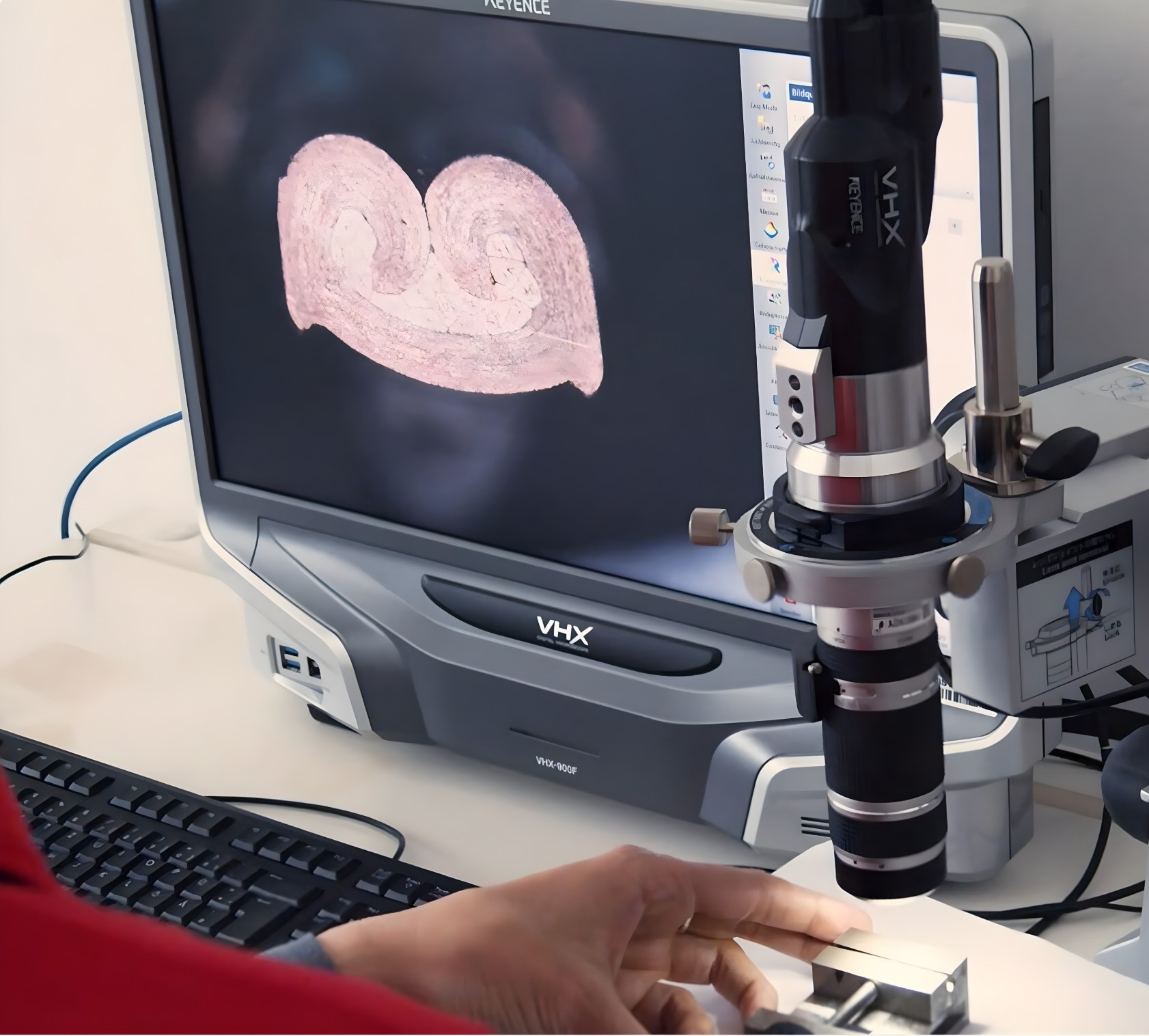
Imagine this: a medical device saves lives, an electric vehicle delivers peak performance, a control cabinet operates flawlessly under extreme conditions. What do they have in common? Precise crimp connections that enable the safe flow of power and data. At CiS electronic GmbH, crimping stands for quality, reliability, and innovation—values that have shaped us as a family business since 1975. But why is crimping the gold standard of cable assembly? Dive into a technology that is indispensable in medical technology, electromobility, and mechanical engineering.
- What is meant by crimping and what is it used for?
- What advantages does this technique offer?
- What are the differences compared to alternative methods such as soldering or screw connections?
- And how do we at CiS ensure that every crimp connection meets the highest quality standards?
What is crimping and what is it used for?
Crimping is a mechanical joining process in which an electrical conductor, usually a stranded wire, is firmly connected to a connecting element such as a ferrule, a cable lug, or a plug contact. This is done by applying targeted pressure with a crimping tool or a machine that deforms the contact so strongly that the conductor and the connecting element are permanently joined together.
The major advantage: when the crimp is executed correctly, it creates a gas-tight, vibration-resistant, and electrically stable connection—without any soldering or additional materials.
Crimping is used wherever cable assemblies need to be connected reliably—wherever current must flow safely and high mechanical resilience must be ensured, crimping is the preferred connection technology.
Why is crimping so important?
Crimping is so important because it is one of the most reliable methods for permanently connecting electrical conductors to contacts. Only a correctly executed crimp ensures that current flows safely and with low loss, and that the connection remains stable even under vibration, mechanical stress, or changing environmental influences. Especially in safety-critical fields such as defence technology or medical technology, a single faulty contact can have serious consequences. That is why crimping is now considered an indispensable standard when it comes to quality, safety, and the durability of cable assemblies.
What advantages does crimping offer?
Crimping offers a wide range of advantages that make it one of the most important connection technologies. One of its greatest strengths is its high mechanical stability. A correctly executed crimp connection withstands even strong vibrations or movement and is therefore particularly well suited for applications in vehicles, machines, or other environments subject to mechanical stress. At the same time, the process ensures permanently reliable electrical conductivity.
The gas-tight compression prevents air from entering, which helps prevent corrosion and keeps the contact resistance consistently low.
Crimping is also highly convincing in terms of efficiency and repeatability. With standardized tools and defined parameters, a large number of connections can be produced in a short time—and with consistently high quality. This aspect is especially advantageous in industrial series production. Another benefit: since no heat is used in crimping, neither the conductor itself nor the insulation is subjected to thermal stress. This reduces the risk of material damage and makes the process particularly gentle on materials.
In summary, crimping offers a combination of mechanical robustness, electrical safety, high efficiency, and material protection—qualities that make it the preferred connection technology in many fields.
What is important in crimping?
For a crimp connection to function reliably over the long term, several factors must be taken into account, as their interaction determines the quality. One of the most important points is the correct combination of conductor cross-section and crimp contact. Only if both match exactly can a connection be produced that is mechanically stable and electrically conductive.
If, for example, a contact that is too large is used for a conductor that is too small, the conductor cannot be fixed securely—the connection would be unstable and prone to failure. Clean stripping is equally important. The insulation must not extend into the conductor or wire crimp. It should be removed only far enough so that only the bare strands are compressed in the wire crimp, while damaging as few individual strands as possible. At the same time, the insulation must sit in the insulation crimp so that it serves there as strain relief and a stable support for the cable.
Another key factor is choosing the right tool. Crimping tools and crimping machines must be matched to the respective contacts and conductor cross-sections. Only then can defined compression forces and consistent crimp heights be achieved. Tools that are not regularly inspected or calibrated quickly lead to quality problems.
In addition to material and tool selection, the crimp shape also plays a decisive role in the quality of a connection, because different geometries each fulfill specific requirements. The square crimp is often used for ferrules and has proven particularly effective in control cabinet construction, while the hexagonal crimp, with its uniformly distributed compression all around, ensures an especially robust connection—above all for high currents and larger conductor cross-sections. The trapezoidal crimp is typically used for cable lugs and provides a stable, form-fitting contact there. The B-crimp is characterized by its closed shape, which compresses the stranded wire evenly and thus enables a secure electrical and mechanical connection. The F-crimp, in turn, is especially suitable for uninsulated plug contacts thanks to its compact design, where only limited space is available. This variety of crimp shapes shows that each geometry has its own strengths and must be selected specifically to meet the requirements of the respective application and the applicable standards.
Last but not least, correct strain relief and bend protection must be ensured. They prevent mechanical forces from acting directly on the crimp point and weakening the connection during operation. The insulation crimp also plays an important role: it encloses the outer insulation of the cable and stabilizes the transition between the conductor and the cable sheath, thereby absorbing additional mechanical loads. In addition, comprehensive quality assurance—consisting of visual inspection, pull testing, and electrical resistance measurement—ensures that every connection complies with standards and withstands the demands of use.
Common mistakes in crimping
Correct execution is crucial in crimping. Common mistakes include:
- Crimping too weakly, for example with a crimping tool, causes the contact to sit loosely and individual strands to slip out.
- Excessive crimping can damage the conductor or reduce the cross-section too much.
- An incorrect cross-section of the ferrule and conductor means that they do not fit together optimally.
- Poor stripping can damage individual strands and reduce the contact area.
Crimping compared to other methods
Soldering is a traditional connection technique in which the conductor and contact are materially bonded together by applying solder. Its advantage lies in the material bond and full-surface connection of a solder joint. However, soldering also has certain disadvantages: the connection is sensitive to heat, can break more quickly under vibration, and flux residues carry a risk of corrosion.
Screw and clamp connections are particularly common where cables need to be connected in a detachable way, such as in installations or in devices that are serviced regularly. They are easy to assemble and disassemble, but they tend to loosen over time—especially under vibration. In addition, they can have higher contact resistance and are more susceptible to corrosion.
In contrast, crimping offers a combination of high mechanical stability, low electrical contact resistance, and good reproducibility. A correctly executed crimp connection is vibration-resistant and pull-resistant, gas-tight, and can be manufactured in large quantities with consistent reliability. That is why crimping is preferred especially in safety-critical fields such as the automotive industry, medical technology, and mechanical engineering.
What tools are needed for crimping?
The right tool is crucial for a clean crimping result. As a general rule, the tool and the crimp contact must match exactly.
- Stripping tools remove the insulation without damaging the individual strands.
- Hand crimping tools are suitable for prototypes and small series, especially when only a few contacts need to be processed.
- Ratchet crimping tools ensure consistently high quality through their defined closing force.
- Semi-automatic crimping machines are ideal for medium production runs in order to combine speed and precision.
- Fully automatic machines are the first choice in series production: cutting, stripping, and crimping are carried out here in a single step.
This makes it possible to assemble individual cables as well as entire cable harnesses reliably and in compliance with standards.
Step-by-step guide to crimping
To ensure that a connection is stable and electrically safe, crimping should be carried out systematically:
- Cutting to length: Cut the individual wire to the correct length.
- Stripping: Remove the insulation so that the individual strands fit completely into the contact.
- Insertion: Insert the bundled individual strands into the crimp contact.
- Positioning: DenKontakt samt eingeführter Litze in die passende Crimpöffnung der Zange einlegen.
- Crimping: Close the tool completely until the defined crimping force is reached, then open it again.
- Inspection: Check the connection: firm fit, no damaged wires, uniform shape.
What types of crimp connections are there?
Not every crimp looks the same, as the shape depends on the application and the load:
- Square crimp: Standard for ferrules, ideal for control cabinet construction.
- Trapezoidal crimp: Frequently used for cable lugs, form-fitting and stable.
- Hexagonal crimp: Particularly robust, for high currents and larger cross-sections.
- B-Crimp: Its closed shape ensures even compression of the stranded wire.
- W-Crimp: It crimps the stranded wire in a wave-like form and provides good mechanical retention.
- O-Crimp: It forms the conductor into a round, closed connection with uniform force distribution.
- OVL-Crimp: It combines an oval crimp shape with additional stabilization for higher loads.
- 4-indent crimp: It compresses the stranded wire selectively from four sides and provides a very firm hold.
- Oval-Crimp: It produces a uniform, oval crimp with good electrical conductivity.
- Indent crimp: It presses the stranded wire inward using one or more indents and ensures high pull-out forces.

Which materials are best suited for crimping?
Choosing the right materials is crucial for reliable crimp connections. Copper conductors are ideal thanks to their high electrical conductivity and excellent formability. Aluminum conductors can also be crimped, but they require special contacts and adapted tools, as aluminum is softer, creeps more, and forms an oxide layer.
Crimp contacts are usually made of copper alloys such as brass and are often surface-finished:
- Tin:The standard for cost-effective, durable connections.
- Silver:Minimizes contact resistance, ideal for high-current applications.
- Gold: Ideal for sensitive areas such as medical technology and for signal/data contacts at low levels, where maximum reliability is required.
The precise matching of conductor and contact material ensures electrically stable, durable connections. At CiS, we use our materials expertise to deliver cable assemblies that move your projects forward reliably.
Questions about the right material choice for your application? Contact our experts!
Tips for a professional crimping result
A perfect crimping result requires precision and care:
- Suitable tools:Use specific crimping tools or machines that are precisely matched to the contact and cross-section. Universal tools often lead to poor-quality connections.
- Observe the crimp height:Maintain the crimp height specified by the manufacturer and use the correct conductor cross-section. Deviations can cause loose or damaged connections.
- Tool maintenance:Regular maintenance and calibration of crimping tools prevent quality losses caused by worn dies or weak ratchet mechanisms.
- Clean stripping:Remove the insulation precisely without damaging strands or leaving too much or too little insulation, to ensure optimal contact surfaces.
- Thorough inspection:Carry out visual inspections; in professional applications, pull tests or microsection analyses complement quality assurance for mechanical and electrical reliability.
At CiS, we rely on certified processes (ISO 9001, VG 96927) and state-of-the-art technology to deliver cable assemblies that meet the highest standards.
Conclusion: Crimping as the key to secure connections
Crimping is an indispensable technique for secure and durable electrical connections. Whether you need to crimp a cable or a connector, this method offers numerous advantages. It not only ensures a stable connection but also minimizes resistance. Crimping cables allows you to create connections more efficiently and increase the reliability of your electrical systems. Modern technology would be hard to imagine without this process.
At CiS, we rely on experience, precision, and state-of-the-art technology so that our customers receive connections they can rely on in every situation.
If you are looking for a partner for high-quality cable assemblies, component assembly (systems technology), human-machine interface (HMI), or development services with tested crimping technology, then you have come to the right place!
Experience a comprehensive service - don't wait, get connected now!
The information in our blog posts is aimed at technically proficient readers and is based on the current state of knowledge at the time of publication. We do not assume any liability for its implementation. **Automatic AI translation**